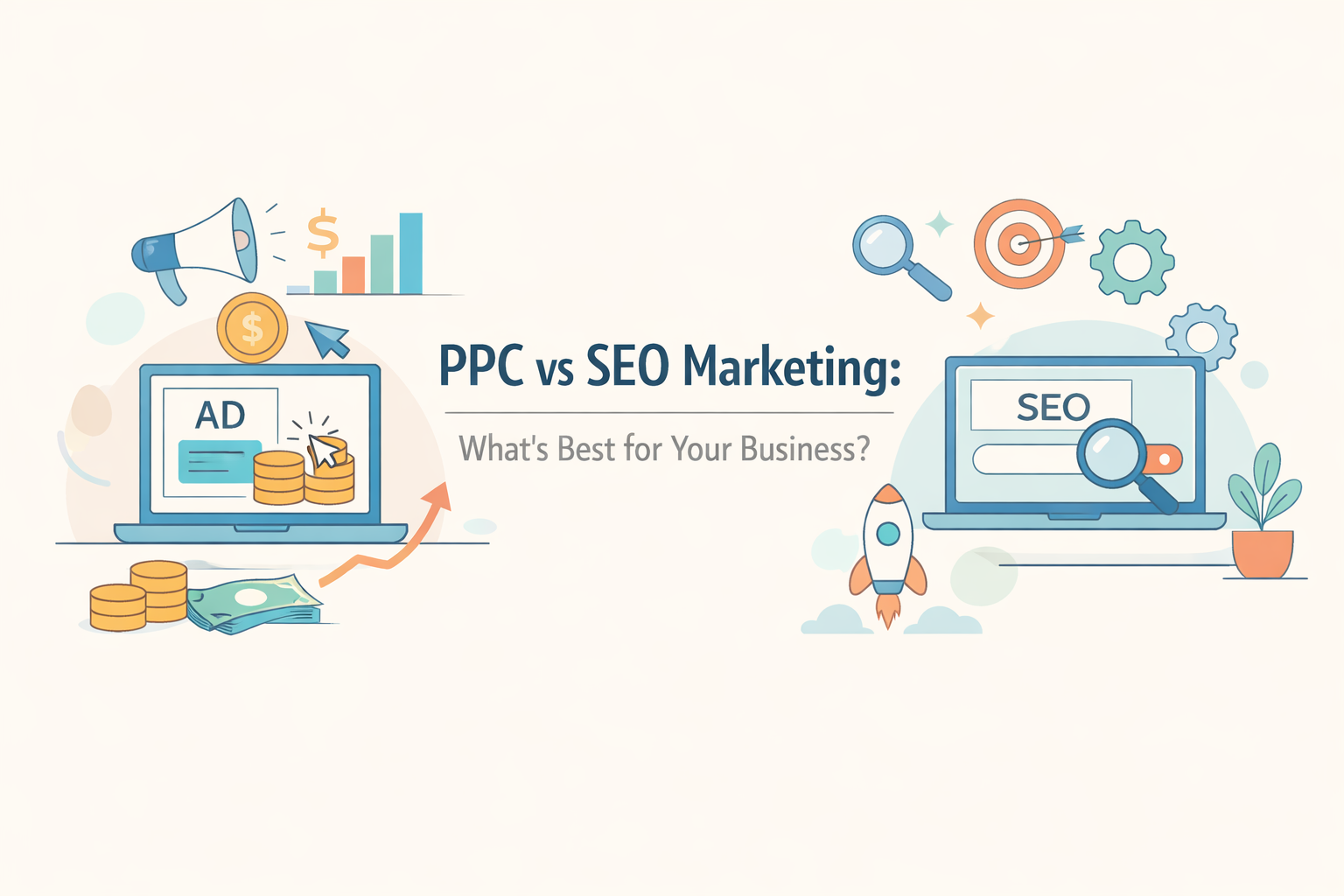
When it comes to growing your business online, two strategies dominate every conversation: PPC (Pay-Per-Click) and SEO (Search Engine Optimization). Both are powerful, but they work in very different ways. Whether you're a startup looking for quick wins or an established brand building long-term authority, understanding PPC vs SEO is critical to making the right investment.
In this blog, we'll break down both strategies, explore their advantages and limitations, and help you decide which is the best digital marketing strategy for small business and large enterprises alike.
What Is SEO? Understanding Organic Growth
SEO, or Search Engine Optimization, is the process of optimizing your website so it ranks higher in organic (unpaid) search results on Google and other search engines. SEO vs paid search is a common debate, but SEO offers something that paid ads simply cannot — sustainable, long-term traffic without paying for every click.
Key components of SEO include:
- On-Page SEO: Optimizing content, meta tags, headings, and internal linking.
- Off-Page SEO: Building backlinks and improving domain authority.
- Technical SEO: Improving site speed, mobile-friendliness, and crawlability.
- Content Marketing: Creating valuable, keyword-rich content that answers user queries.
- Local SEO: Optimizing for location-based searches — essential for local businesses.
SEO is a marathon, not a sprint. Results typically take 3–6 months, but once your pages rank, you receive consistent traffic at little to no ongoing cost.
What Is PPC? The Power of Paid Search
PPC marketing (Pay-Per-Click) is a model where you pay a fee each time someone clicks on your advertisement. Google Ads is the most popular PPC platform, placing your ads at the top of search results for chosen keywords. PPC and SEO strategy often go hand-in-hand, but PPC delivers immediate, measurable results.
Top PPC marketing benefits include:
- Instant Visibility: Your ad appears at the top of Google the moment your campaign goes live.
- Precise Targeting: Target users by location, device, age, interests, and even time of day.
- Measurable ROI: Track every click, conversion, and dollar spent in real time.
- Scalability: Increase budget on winning campaigns or pause anytime.
- Competitive Edge: Appear above organic results — even outranking stronger competitors.
- Retargeting: Re-engage users who visited your site but didn't convert.
PPC is ideal for businesses that need fast results, have a clear budget, and are targeting high-intent buyers ready to make a decision.
PPC vs SEO: A Head-to-Head Comparison
Let's compare both strategies across the most important factors:
- Speed of Results: PPC delivers immediate traffic. SEO takes 3–6 months to show significant results.
- Cost: PPC requires ongoing ad spend. SEO has upfront investment but lower long-term cost.
- Sustainability: SEO provides lasting results. PPC traffic stops the moment you pause your budget.
- Trust & Credibility: Organic results are trusted more. Users often skip ads and click organic listings.
- Click-Through Rate (CTR): SEO typically achieves higher CTR over time. PPC CTR varies by industry.
- Targeting: PPC offers granular audience targeting. SEO targets intent through keywords broadly.
- Best For: PPC suits product launches and fast wins. SEO suits long-term brand building.
Which Is Better: SEO or Paid Ads for Your Business?
The answer depends on your goals, timeline, and budget.
Choose SEO If You:
- Are building a long-term online presence and brand authority.
- Have a limited budget and want sustainable growth over time.
- Are targeting informational keywords and content-driven industries.
- Want to rank for multiple keywords simultaneously without per-click costs.
- Are willing to wait 3–6 months for meaningful traffic growth.
Choose PPC If You:
- Need immediate traffic and leads — perfect for new businesses or product launches.
- Are running time-sensitive promotions or seasonal campaigns.
- Operate in a competitive industry where organic ranking is extremely difficult.
- Have a clear budget and a high-converting landing page ready.
- Want to test new markets, products, or offers quickly.
SEO or Paid Ads for a New Website? Here's the Answer
If you have a brand-new website, this is the most common question. The truth? You likely need both — but in a smart sequence:
- Launch with PPC to generate immediate traffic, leads, and revenue while your website is new.
- Simultaneously invest in SEO to build domain authority, content, and long-term organic rankings.
- As SEO kicks in (month 3–6), gradually reduce your PPC spend on keywords you now rank for organically.
- Reinvest PPC budget into new markets, retargeting, or high-competition keywords SEO cannot yet win.
The Power of Combining PPC and SEO Strategy
The most successful businesses don't choose one over the other — they integrate both into a unified strategy. Here's why the combination works so powerfully:
- Dominate the SERP: Your brand appears both in paid ads (top) and organic results (below), doubling your visibility.
- Use PPC Data to Improve SEO: Identify your highest-converting keywords from PPC and target them with SEO content.
- Protect Your Brand: PPC ads protect against competitors bidding on your brand name while your SEO grows.
- Fill the Gap: Use PPC during SEO's slow initial months so you're never without traffic.
- Reduce Overall CPC: As your Quality Score improves (thanks to great SEO-optimized landing pages), your PPC costs decrease.
Best Digital Marketing Strategy for Small Business
For small businesses with limited budgets, here's a recommended roadmap:
- Month 1–2: Invest in local SEO (Google Business Profile, local citations) and run a small PPC campaign to generate initial leads.
- Month 3–4: Ramp up content marketing and blog posts targeting long-tail keywords with low competition.
- Month 5–6: Analyze PPC data — pause underperforming ads, scale winners. Double down on top-performing SEO content.
- Month 6+: With solid SEO rankings in place, shift primary budget to content creation and link building, using PPC selectively for promotions.
Why You Need the Best Digital Marketing Company
Managing both PPC and SEO simultaneously requires significant expertise, tools, and time. Partnering with the best digital marketing company ensures your budget is spent wisely, your campaigns are data-driven, and your long-term strategy is built on a solid foundation.
A great digital marketing agency will:
- Conduct in-depth keyword research for both PPC and SEO.
- Build high-converting landing pages optimized for Quality Score and organic ranking.
- Create a content strategy that targets every stage of the buyer journey.
- Provide transparent, data-driven monthly reporting with clear ROI metrics.
- Continuously optimize campaigns — never set and forget.
- Stay ahead of algorithm updates and paid search platform changes.
Conclusion: PPC and SEO — Better Together
So, PPC vs SEO — which wins? The honest answer is: neither wins alone. The smartest businesses use PPC for immediate visibility and conversion while building SEO for sustainable long-term growth. Whether you're asking "SEO or paid ads for new website?" or wondering how to scale an established brand, the answer lies in a strategic combination of both.
Understanding your business goals, budget, and timeline is the first step. From there, working with the best digital marketing company to build a unified PPC and SEO strategy will give you the competitive edge you need to dominate your market in 2026 and beyond.